Episode Transcript
[00:00:00] Speaker A: Sound amazing and it all looks exactly alike. But the question is, is that making you more money in tax and investing
[00:00:06] Speaker B: AI is so amazing and so scary at the same time. Like it's just unbelievable. And this is what the infomercial sector does in our space is they will oversell something or basically make it sound like gold, but it's foolish gold.
[00:00:20] Speaker A: Unless the person who's programmed the software knows what they're doing. I wouldn't trust the software.
[00:00:26] Speaker B: That's the danger zone. When you lose in the space, it's no difference. If I had a lottery ticket yesterday that didn't hit and it's a, it's a losing ticket. I've got it and I sell it to you for par. I sell it to you for face value.
[00:00:41] Speaker A: Quick note before we continue. Nothing we discuss in this podcast should be considered legal, financial or investment advice. Tax lien laws vary significantly by state and every property situation and investor is unique. Always consult with qualified legal and financial professionals in your jurisdiction before making any investment decisions.
Now let's get back to the show.
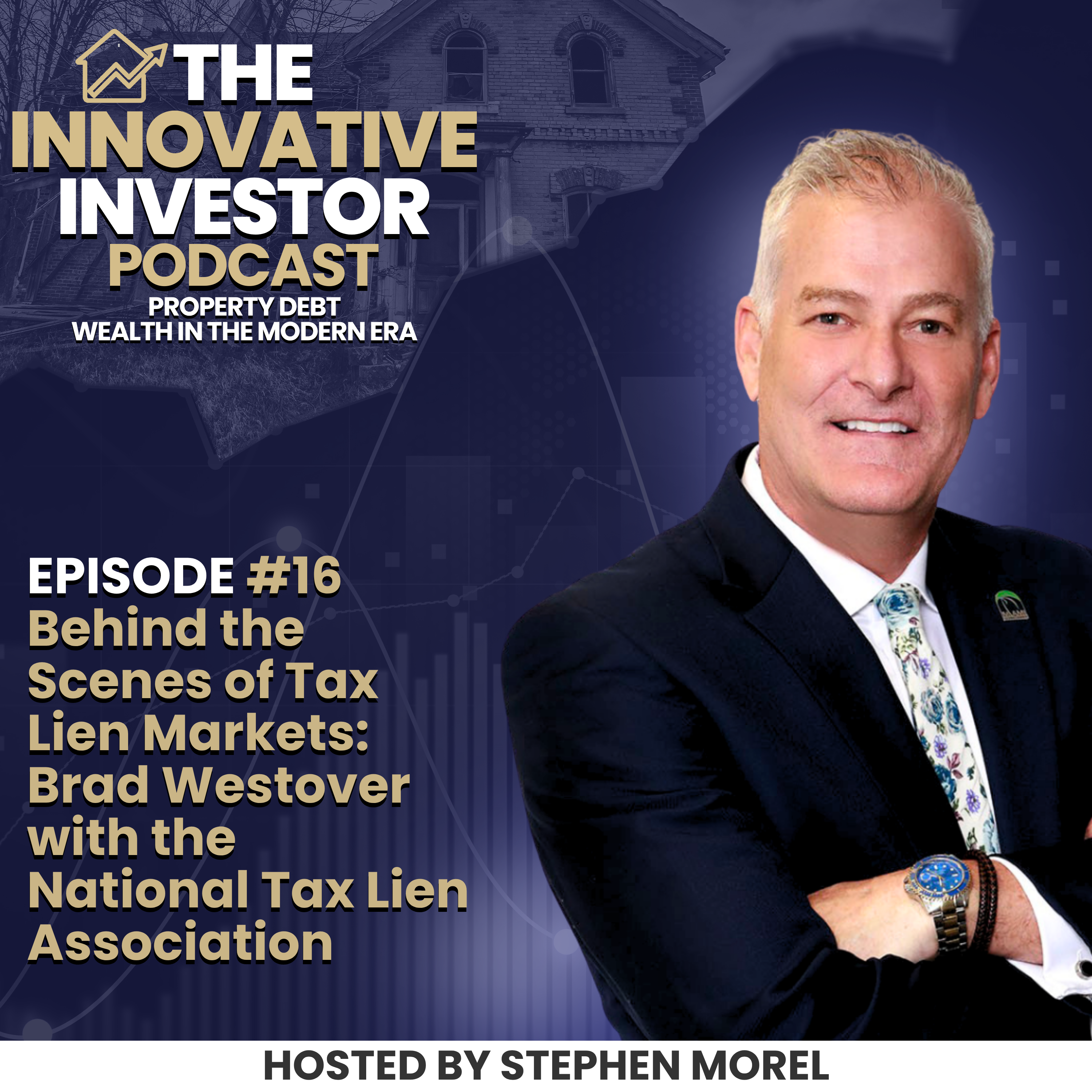
Welcome back to the Innovative Investor Podcast where we explore how data technology, legal insight and better systems are changing real estate and property debt investing forever. I'm Stephen Morrell, founder and CEO of jurisdeed and today I'm joined by Brad Westover, executive director of the National Tax Lien Association.
Bryant started investing in tax sales in 1995. He's helped shape the industry through investor education, professional standards, and the MTLA foundation, which helps elderly and disabled homeowners facing tax foreclosure. That gives him a perspective beyond any single deal. He sees the investor, the local government that needs revenue, and the homeowner on the other side of that transaction.
We're going to talk about what makes this market work, where investors get it wrong, and what it takes to make tax sale investing more accessible without lowering the standards.
Brad, welcome to the Innovative Investor podcast.
[00:02:01] Speaker B: Stephen, thanks for the invitation. Great to be here. Great to have this conversation.
[00:02:06] Speaker A: Awesome. Well, let's dive right in, back into it. So you and I were have talked many, many times of course, up to this point. And so I want, for the benefit of our listeners and actually for my own memory, take me back to 1995 and Brad Westover's life. What brought you into tax sale investing?
[00:02:25] Speaker B: Yeah, great question. Well, so here's, here's, here's the genesis. 30 years ago, 32 years ago, I was graduating from college and my father in law was actually in the space for a group called Capital Asset Research Corporation. He tells me about tax liens. And he recommended a book for me to, to learn a little bit about this called the 16% solution, which was ridiculously ahead of its time. I mean this was, this was 30 something years ago when it was really a mom and pop industry.
And, and this group, Capital Asset Research Corporation out of West Palm Beach, Florida decided to institutionalize it. And how it happened was the CEO, Dick Heitmeier, own property in Florida and he was at his second home in Texas and he got a notification that he didn't pay his taxes and someone purchased the tax lien for 18%.
And he goes, what in, when he went to redeem, he's like what in the world? And in, in, you know, the guy was, the guy was very innovative, very sharp and he goes, wait a second here. 18% got a line of credit with Lehman Brothers, got some equity and he was off and running and quickly accumulated, very quickly accumulated like $300 million.
But it was not without its fair dangers. And I'll get into that a little bit, a little bit later. The genesis of bidding and dominating auctions. But I got a call from my father in law who was like the number five employee of this company.
And he said, hey, we want to go to California, but California doesn't have legislation. I know you're from California. Do you know anybody?
And my best buddy from high school was Pete Wilson, the governor, Pete Wilson of California's press secretary. So I made a phone call, I set up these meetings with Governor Wilson and his cronies and they liked me. This, that, you know, Dick Heitmeier and the group came out to have these, you know, really important meetings with the state of California to get them to, you know, hear what tax lien, certificate sales were all about. And then they, they said when do you graduate? Is that I graduate in 45 days. And they made me an offer.
The only crazy thing was the offer was move from California to Florida and we'll train you for three, we'll train you for three months and then we'll send you home to California.
And so with one, with a baby one month old and my wife, we, we threw all our stuff in storage and we trekked across the United States and we, we've been here since, for 30, 31 years. Never left.
[00:05:03] Speaker A: Wow. So yeah, it's, that's, that's it. Right? That's the same way everybody gets into it. Right.
[00:05:11] Speaker B: You get, the crazy thing is the, you get sucked into this space and because it's so niche, there's really there's really a, you know, so not, not that, you know, not that many people that are experts or, or, you know, really, it's really easy to understand on the surface, but when you start diving in and start having more experience, you really kind of puzzles, wow, how do these liens. Why do these liens redeem? Why do these not redeem? And then you learn, oh, my gosh, not all liens redeem. There's a real estate component to this technology component. But one thing about it is every single year, there's a new cycle of people not paying their taxes. There's government that always needs their money.
And we, you know, and we do a great job of, of filling that void in turning properties around and painting fences and mowing lawns and getting rid of code enforcement violations and everything that, that our industry does. That's fantastic.
So, you know, it's, it keeps you in, it keeps you in this space. Me for 30, 30 years.
[00:06:15] Speaker A: That's awesome. Thank you for sharing all that with us. And it's a great segue into something I, and I don't even know if this was the, the next thing I wanted to ask you about or the 20th thing, but here goes, we're going to do it anyway. So the segue I wanted to get into, based on what you just said, is how the industry is perceived by the outside. When I say the outside, I mean anyone who's not currently, you know, actively investing in it or teaches in it or whatever, who understands it, you know, in my experience, most people have no idea what a tax lien is.
Even attorneys and professionals who are, you know, are more highly educated, if you will.
And then the, the general stigma that I've come across is, you know, it's kind of, you know, you're preying on someone else's debt, someone else's hard times.
You're. You're trying to profit from someone else's loss. I mean, all these kind of things. Right. And so how do you, what's your take on that and how do you respond to it?
[00:07:17] Speaker B: So that's a great question, Stephen. And I'll tell you the reason I'd stay. I've been the executive director of the NTL. Well, I've been a member of the NTLE since 1997 when it was founded. I was part of the original founding meetings. They had another executive director previous to me that was a former tax collector in Escambi County, Florida.
But I was a part of those original meetings and realized, wow, this wild, wild west industry, that's not regulated. Needs someone to be the adult in the room. Someone needs to, you know, play this role of, of monitoring legislation, introducing legislation, public relations campaigns and things like that. Because it's an industry that is perceived from the outside, I would say perceived as a bunch of bottom dwellers, like a bunch of carp in the river just chewing off the bottom. And the reality is some of the, some of the finest people I've ever met on the planet are part of this space.
And, and I would consider myself a very high moral character. And I'm in the space because, and I, and I remain in the space because I believe in what we do.
I believe wholeheartedly that our industry is a really great industry. But in order for it to be a great industry, it has to benefit. This whole process has to benefit four different groups. Does it benefit the local government? The answer is yes. The local government needs funds to operate for the services in which we all enjoy. That's emergency services, roads, parks, libraries, public, public pools, whatever the case may be. All the things that, that, that we, we benefit from. One government. Number two, does it, does it benefit the, the investor? Well, yes, there's a, there's a risk adjusted return for the rate in which you're going to bid on this, on this risk of buying a delinquent tax certificate or a tax deed. Number three, does it benefit the current taxpayers? The answer is yes. Through this process, you don't need to raise taxes. Your budget gets filled every year with the government, with the hole that was created from people not paying their taxes. And then lastly, does it benefit the delinquent taxpayer? And the answer is generally yes. Not always. In all 30 states that do tax lien sales, but in general there's a statutory rate, there's a bid down interest rate and you know, or maybe there's a longer redemption period. But the reality is if it answers, if it can benefit those four groups, those four stakeholders, then this process is great. In America, if property taxes were voluntary, that would be a problem. If it was voluntary that I got to pay my taxes and this year, hey, I don't feel like it, someone else is going to pick up the slack. Then ultimately there has to be. With any other, like any, with any tax, there has to be repercussions for the non payment of taxes. So the repercussion or the ultimate hammer is a tax foreclosure of which you have the threat of losing your property.
But the, but the, you know, the lion's share of people, when it comes down to it, you don't lose your, you don't lose your owner occupied residence from not being able to pay your taxes. That happens to less than 1/2 of 1% of people in America or even delinquent taxpayers in America. It's less than, less than 1% actually get tax foreclosed.
So what does get tax foreclosed in general is vacant. Vacant commercial property or vacant land are the two categories that mostly that goes all the way, someone walks away from it. But you know, the beautiful byproduct of our space is we have this whole group of tax deed investors in America that love cleaning up code enforcement violation, cleaning up title issues, cleaning up stuff. And then like I said before, painting fences, mowing lawns, pulling trees out of houses through the roof, you know, doing the repairs necessary to, to alleviate blight in, in America.
[00:11:17] Speaker A: Yeah, everything you just said. And I can, I can echo that. At Juristeed, we help investors to manage the, the asset management throughout the whole life cycle, using technology to make it more accessible, more and more successful. And a lot of times we come across, you know, other parts of the industry could be the tax debtor, could be the collectors, it could be the, you know, just other people in the tech space that don't understand what this is all about.
And it's, it's usually just like a kind of a curious look on their face or if they have some preconceived notion and I had to sit there and explain to them, you know, it's a contribution into creating communities that, that are, that are worthwhile living in. Right. That's what tax paying taxes are doing. And when you, when taxes don't get paid on time, it's, you're hurting the, your community. You're not, it's, it's not you. But the, the lack of that tax revenue is hurting the community.
And so, you know, what are your options? You can cut spending or you can raise taxes on everyone else. Right?
Both things that no one really wants to happen. Those are not great results.
And so what are the choices? Well, the government needs it that year because as you mentioned, it's a cyclical thing. Guess what? In six months there's been another bill coming out. Right. And so, you know, investors play a part in this flywheel that it really is creates stable and healthy communities across the country.
And without it, it wouldn't be possible, you know, not certainly not at the level that everybody wants it to be at. You know, so there's a, there's a,
[00:12:56] Speaker B: there's a buzzword around our space in the last Two years, called. Called equity theft.
And equity theft was a term that was given by this. By a. By some. Some group. And it talked about the theft of equity, theft of, of our space. Stealing equity from a delinquent taxpayer. You know what, you know what the redefin theft is in my book?
The one thing I've learned in the space over the years is these properties do not tax. Delinquent properties do not get better with time without intervention.
So if you told me, hey, Brad, in. In Timbuktu, Nebraska, there's a delinquent tax. Just give me the street name, I'll point out which property it is. You don't have to tell me. I can find it. It's the one with the tree growing through the roof, and it's the one that has a lawn that's three feet tall.
You know, that's, it's. It's. So.
So what I'm getting at is, you know what equity theft really is? When those same properties look like that, you steal equity from your neighbors because every property in the neighborhood declines in value.
[00:14:06] Speaker A: Yeah.
[00:14:07] Speaker B: So the moment you come in and you say, hey, time's up, redemption period is over.
Someone buys a tax deed now the code enforcement violations go away, they redo the driveway, they paint the house, and now, you know, all is well in love and war that, yeah. You know, everybody's equity goes up when there's not a board up in the neighborhood.
That's what our industry does.
And it may not be the most glorious thing in the world, but guess what? I'm glad that there's people raising their hand saying, hey, I like it. I like to turn something that's really ugly into something beautiful and enhance the community.
[00:14:47] Speaker A: Right, Right.
Well, I want to cover a bunch of stuff within the time we have, and for one of them is kind of getting back to basics a little bit. Because the industry has taken a lot of twists and turns over the last four or five years.
As most of our listeners know, we're. We follow the Supreme Court decisions pretty closely because we're.
[00:15:10] Speaker B: We're.
[00:15:11] Speaker A: We're tech, but we're legal tech. And so, you know, we're.
[00:15:14] Speaker B: We're.
[00:15:14] Speaker A: That it's one of the, One of the challenges. Right. Of being successful in the space is staying ahead of those types of things and knowing where it's going and if it changes, you better know how to adapt your business model.
But so just to cover a couple of basics, though, I want to hear from. From your educated experience perspective, and I'm sorry to put you on the spot like this, but you are my guest, so that's how it goes.
What's the simplest way you can. Brad Westover, Executive director of the ntla. What's the simplest way to explain the difference between buying a tax lien and a tax deed? We're going real basic here for a minute.
[00:15:50] Speaker B: No, that's great.
Years ago, years ago I was made a presentation to the city of, of Pittsburgh. I was in Pittsburgh, Pennsylvania and I was young. This is a long time ago. I was 20 something years old and I had made a, I'd made a presentation, a PowerPoint presentation for the city council that had to vote on whether they wanted to sell in bulk.
And we were in, you know, their connections were made through a law firm that was there. And we did a dry run of the presentation before me and a colleague of mine. And we started with slide number one, tax lien, tax deed, what's the difference? And then built from there, assuming the city council knew nothing, took them from ground zero to two, the law firm. And the dry run goes, hey, you guys are off the, after we're done, you guys are off the hook. We got it from here. And they scrapped the presentation and they did their legal talk or whatever. And I'll never forget. So I'm sitting there, I literally got up in the presentation, grabbed a bagel and cream cheese that was on the side and I'm watching this thing go on.
And the last question before we departed was one of the city council rep goes, I just don't understand what's the difference between a tax lien and a tax deed. And I'm like, dude, you guys. Anyway, I was, I was kind of ticked, but made me, it made me laugh. But here you go.
A tax lien certificate is a lien issued by the local government. Whether that's a county or a municipality depends on how the, you know, the taxes are collected by the state.
In New Jersey, there's 567 municipalities that collect taxes, so they run at a municipal level. In Florida, there's 67 counties that handle tax collection. So each jurisdiction, they do what they do. But if you don't pay your taxes, the local government places a lien on the property for the taxes owed. It's a priority lien ahead of the mortgage.
It's on par with any other municipal lien. So code enforcement, violations of municipal lien, that's on the same level as a tax lien, IRS liens, or federal liens that are on the same level as a tax lien but everything below that, a mechanics lien for someone you didn't pay, the plumber that fixed the house or whatever other liens that go, they're all subordinate and they're all, they're all wiped out when it comes to a tax detail. So a tax lien is the paper that you buy or the, you're buying the right to an interest rate.
So you pay the penalties and the interest. And then the people have a delinquent, a redemption period to pay their taxes. So they pay the principal amount that was owed and the interest, any penalties and interest to the, to the local government, generally to the local government. And then they forward onto the, to the tax lien investor. So that's a tax lien or a tax lien certificate. Kind of use those together. So you're, you're not buying the property you're buying, you're buying an opportunity to earn interest.
You're also, you're also investing in the risks that they don't pay. And if they don't pay, then there's different ways to handle that. But ultimately redemption period either expires or is comes to the, comes to the end and the lienholder has to file a tax foreclosure.
That's done in two different forms in America. It's done judicially through the courts or it's done administratively through the local government.
So there's two different ways to handle that. And that's just with history of how local governments want to do their tax foreclosures.
So that's a tax lien certificate. A tax deed is.
Redemption period is up. You are now doing due diligence on a property, whether that's land, vacant land, commercial building, a home, a townhome, whatever that runs the gamut. So what the property is.
And the opening bid at these auctions is generally the taxes owed.
So that's the opening bid. And you are, you know, it's a whole. The thing that's wild about the two different spaces tax lien certificates and tax deeds are. Those worlds kind of collide in the fact that one forces the other. But really these, most of these tax deed investors are kind of regionalized mom and pops, little companies that love to do renovations. And these are, you know, who knows what. But they, you know, it's generally not always, generally not the same people buying tax liens as buying tax deeds.
[00:20:29] Speaker A: Yeah.
[00:20:30] Speaker B: And just. But it's based on people's level of comfort. Well, you want an arbitrage spread from tax lien certificates on the investment side or do you want to take property and turn it around?
[00:20:42] Speaker A: Yeah, I, I, we, that's a, that, that's a very, that's a good distinction.
And, and it's, it's one that comes up a lot in, you know, social media and, and on other, you know, podcast recordings we've had.
And the common misconception by the uneducated and I don't mean that in a negative way, but I mean, if you're just not familiar with tax lien investing is that it's a great way to get property. And I have to stop and tell, no, it's not right. There are way better ways to get to become a property owner than to buy tax lien certificates. In fact, it's one of the worst ways because you have about a 99.5% chance of failing. If you.
[00:21:24] Speaker B: 99.5% chance of failing. And then, and then you talk about adverse selection and then what did, yeah, what, what you didn't want is actually what's, what comes through the pike if it, if it does. So. Yeah, no, exactly, exactly. We make the mistake, we make the mistake here of wrapping everything under this umbrella called tax sales.
[00:21:43] Speaker A: Right.
[00:21:44] Speaker B: So we say tax sales. Well, a lot of, most people don't understand that under that umbrella is tax lien sales and tax debt deed cells. And so we really kind of do a little bit of a disservice by just, just using the term tax sales when most people don't understand the difference. So thanks for, thanks for asking the question.
[00:22:05] Speaker A: Yeah, yeah, definitely.
It seems like it's tax sales 10 to 1 and it really is, but it comes up more than anything else, like what the heck is this thing we're talking about? I want to lean into your own personal experience investing because I know you've been at it for a long time and I know the listeners of our, on our show are really looking for tactical advantages and, and strategies and successful at this in 2026. Industries changed quite a bit since 1995, but you've been there the whole step of the way. So what, what would, what checks do you do? What, what due diligence do you do? Would you have to do today before putting your own money into a tax lien in 2026?
[00:22:44] Speaker B: Yeah, great question. Well, it, it, I'll tell you, it has changed a, you know, from back in the, back when I started, we were running around literally with like those, those kind of, it was the early onset of the, of, of digital cameras, but they were digital in the fact that you had A the cameras, we had these Sonys that had these big floppy, they weren't floppy disks, but they were the insertable whatever. And anyway, we, but we were driving with physical maps doing, you know, do physical maps, following whatever and taking pictures and writing down inspection reports and yeah, today's world, Today's world is so different. But you're the holy grail that your listeners want to know. And I'll give you, I'll give you some, I'll give you a, I'll give you something worthwhile.
It's, it's like you're, it's like you're panning for gold in the wild, wild west days. So you're out in Lake Tahoe, in Reno, sifting for gold in, in the Truckee river and you've, you're, you know, you're, you've got your pan and you're sitting there sifting through the, getting rid of the silt and trying to find some gold nuggets.
The filters that you use, you know, and hey, AI is getting smarter. It's smarter tomorrow than it was today and just keeps getting better and better and better. It's just amazing the technology, what it will do to help you understand filtering.
You know, when I say good tax liens, there's two different ways to look at that. There's tax lien certificates that will redeem and give you an interest rate.
Or, or some of your listeners are like, hey, some people listening are like, hey, I'm not interested in that. I want some that are, they're actually not going to redeem. So I'll just tell you. But the filters that you have in here, It's, there's a, there's a whole bunch, but in, in. And I have a course and NTLA has a course called, you know, a tax lien certificate investing course that has all the filters that I could think of in there.
And then we're launching a tax deed investor course in the next week to help tax deed investors understand this is the biggest module in both sectors, which is you have to know your due diligence. You have to know what filters to be able to stay safe and staying safe on good investment on the tax lien certificate side or good investing on the tax deed side, obviously. But let me just give you some of the filters.
Land use classification. Do you understand the underlying asset? What is it? What's the lien amount? The, the biggest. You know, there's two, two financial equations to help you stay safe. LTV ratio and an HLTV ratio, which is Lien to value ratio. So what's the lien amount? What's the underlying value of the property? Divide that number.
The lower the number, the higher the probability the thing will redeem.
The HLTV is a horizon lien to value ratio, which means if this doesn't redeem and I have to tax foreclose, you lump in all your other costs, your legal fees, it hasn't redeemed for another year, that you had to spend money for the next year's certificate, all these things. And then you take that number and those are two, those are two really important financial equations that you have to know in this space.
But you should know the lien amount, the amount of the underlying property.
How many years outstanding has this been? You know, is this one year outstanding or is this eight years outstanding with no current meaning?
You know, what's the average payoff? Does a person pay off their lien every year for the last seven years in December for whatever reason? He pays in December.
Are there any other liens attached? Is there an IRS lien? Is there a municipal lien? Is there any other liens attached to this property?
What is the improved value amount? What is the land value amount?
What is the owner's name? I'm not, I don't want an owner's name that says petroleum, whatever Petroleum, National Petroleum Corporation. And I don't want to buy an old defunct gas station or old dry cleaner.
You know, that's, I say I don't want to because I'm not an expert in pulling out gas tanks out of ground and doing the EPA clean up on it. But guess what?
Maybe there's one.
Someone does it. Someone does it.
So if someone is doing that, then you know what? I suddenly look at really dirty tax liens and go, hey, is there any, are there any old dilapidated gas stations that haven't paid their taxes? Because I still love, I still love where it's located and I think I can clean this up and turn it around. Okay, great. How about it? Just, it's just not me.
So those are, those are some of the filters. There's, you know, I could give you 20, 25 filters that said, hey, you know, you just twist it and see and that's your risk tolerance.
But let me just give you, let me give you one thing to play if you're going to play in a sandbox.
Some of our invest, Some of the members of the NTLA are hedge funds that, you know, that's not like they ran out of money, they simply ran out of good liens to buy.
So, but they stay within a defined, defined box. They love single family homes. They love town homes because those are the highest redeeming categories.
They aren't interested in getting liens that turn to property because they're not property experts. They're, they're financial services companies that park some money. It redeems and they, they like the space.
Yeah, but I'll give you one.
So for a local that says how do I play in this competitive space?
Well, how about taking the list of delinquent properties available and go and, and getting it and going against the building permits like what building permits have been filed and seeing what builder didn't pay their taxes because you know they're going to, they just haven't done it yet.
Or it comes up as, it comes up in the delinquent tax sale as vacant land and yet they're 30 days away from getting a certificate of occupancy because they built a multifamily apartment complex.
And you're like, you know what, the large investors aren't going to do that level of due diligence.
But you know those are little pockets. And I, and I, I look at the two like a large hedge fund is like a, is like a Royal Caribbean massive cruise ship. And the lar in the single family, the, you know, the, the single single person investors on a WaveRunner, you can maneuver way quicker on that wave runner to get around and whatever.
And you're way more of a local expert if you want to buy something near your home, obviously.
[00:29:55] Speaker A: Right, right.
So that's a good, another good segue. Brad. You just, you seem, it's almost like I gave you the script.
So you know, which by the way
[00:30:08] Speaker B: he hasn't, I haven't seen questions.
[00:30:10] Speaker A: So this is all, I'm not even using a script. I, I wish I had a script right now.
So, so this is what we're gonna get to the kind of the heart of like of one of the main subjects that, that we live in in our company and in our, and our customers and our, and our listeners typically find themselves in which is technology.
And the way I think that technology has and I, and of course I mean technology is pretty broad. Right. And I mean everything that that could mean, including AI Particularly the topic of the day or of our era really.
And what I mean by that is how it impacts the ability to be successful in tax lien investing.
And it used to be where some of the largest funds that were in tax lien investing would, would just have deep pockets. So they could hire their own tech staff, they could build their own, their own systems to manage their operations and, and their, you know, the auction list and everything.
It's becoming so much more democratized now because the ability to access that level of institutional grade technology is 20 bucks away almost. I'm exaggerating a little bit, but it's just way more out there.
But the problem is knowing how to wield it and how to really translate that into results for your bottom line and your ROI of your portfolio.
Anyone can spin up a dashboard, a website, a, a social media post in a blink of an eye now, right? And sound amazing. And it all looks exactly alike by the way.
But the question is, is that making you more money in taxing, investing? So with that in mind, where do you see technology really being the biggest benefit to taxing investors in 2026 and in the near future in really affecting their bottom line in a positive way?
[00:32:06] Speaker B: So very good question. I mean, AI, AI is so amazing and so scary at the same time. Like it's just unbelievable. But you know what, it's when I say it's amazing, it's amazing when you're utilizing it and you're building cool stuff and whatever. When it's scary is when someone else is doing it.
So I look at, I, I, it's, I look at, I looked at two different, two different people that I've never, I've been at the space for 30 years. I know most of the people in our space and I reviewed two different technology platforms in our space that looked amazing.
And yet I know I'm, I'm quite certain they would start out where I started out, which is in, let me tell you. So the, going back to where we started.
The, the president of, of, of the company that I started with, Capital Asset Research Corporation, he was paid on volume, he was paid a percentage of what he bought. So at the end of the day, even though we, we had amazing technology for what he invested in, he, when the, when the auction started, he would say screw it, just buy everything. Buy everything, Buy everything.
So he sold off the company. And the first thing, the company that we sold to, they took a, I think 163 million dollar write off.
Bad for bad acquisitions. You can't buy, you can't buy some of this stuff because it's under, when I say it's underwater, the lien amount is greater than the value of the, of the property. So what are you going to do with it? You just overpaid for it. And there's no, I Know when you know, and this is what the infomercial sector does in our space is they will, you know, oversell something or basically make it sound like gold. But it's fool's gold. It's total, you know, it's swamp land in Florida or it's desert in the middle of nowhere, Arizona, where you're like, what are you going to do with that? It's, you can have a desert farm or a cactus, A cactus farm.
Or are you going to have an alligator farm?
Because it just, you can't build on it. There's no electricity, there's no utilities, there's no nothing. Like, what is your solution to this property you just paid X dollars for?
So there's no doubt, there's no doubt AI is going to make the data side's so cool. It's so cool that the data is becoming better and better and better as far as it's.
And that has been like the holy grail for people that have been in space for, for 25 years plus is they have data on their side that they were the owners of. Like they knew redemption patterns because they had their own track record and they weren't willing to share that with anybody. But nowadays, nowadays this, you know, the models are out there, they're very easy to come by the building.
But the, you know, the mistake is when it comes down to it, and I think the space that we're safe in is our, this industry, especially on tax deed investing is really high touch.
When I say high touch, it's someone's gotta, someone's gotta do the, you know, a bunch of real labor.
And for the foreseeable future, I don't see robots doing all this labor.
Someday, someday that's going to happen, I'm sure. But it's not, it's not tomorrow.
What is right now?
I don't know the number, Stephen, but I, I just said to Morgan at my, at our office, I said, I, I evaluated these two different software programs of people coming out with their, you know, their platform to give people access to investing in our space.
And I go, this is one of 50 that will come out in 20, 27 or one of a hundred or maybe thousands.
I just don't know who's behind the development. I do know, but who's behind the development. Maybe they're smart people, but they don't know anything about our space.
[00:36:30] Speaker A: Yeah, yeah. We have this conversation frequently in our, in our, inside of our company, our team, because look, there's apprehension about, about, you know, surrendering your human Independence and, and what makes us unique and special and, and what we value and you know, and outsourcing that to a computer and you know, it's the way, the way that we talk about it is that what we're doing on the more of the legal and title side of the fence of, you know, after you acquire it, then what do you do, you know, how do you maximize, how you stop stepping into pitfalls, how do you prevent risks? How do you, how do you increase returns without increasing staff?
And how do you transcend through, overcome some of these, these complexity barriers that, that are state and federal laws that are always changing and influx and you know, all that kind of stuff.
And unless you know the person who's programming the software knows what they're doing, I wouldn't trust the software. And I think you hit the nail on the head a minute ago.
Who's right? Who's putting the software out? Because again, a really flashy, cool looking landing page can be done by a 5 year old right over in a weekend.
The question is, do you know, can you pull that off and not lose my money?
And, and that's what investors should be asking is like who's behind, who's the wizard behind the curtain? You know, and, and it, you can't substitute that because AI will do whatever you ask it to do, right? With it.
[00:38:15] Speaker B: It's like, it's like a, it's like a puppy dog that wants to please you. Like, it's just, it wants to be petted. And you, you know, it's just going to keep feeding you, just going to take you down the road you want to go, hey, right?
[00:38:28] Speaker A: Yeah. Because the more turn it takes, the more tokens it burns.
[00:38:31] Speaker B: Yeah. The danger zone. The danger zone is there's no shortage of very naive people in America that have some funds because they, they work for 30 years, they have a retirement fund and now some Yahoo is going to create a snazzy site and then he's going to just, he's going to load up garbage liens and sell them.
That's the danger zone is like when you lose in the space, you, you know, when you lose in the space, it's, you lose. It's, it's no different, Stephen, than if I had a lottery ticket from yesterday that didn't hit. And it's a, it's a losing ticket. I've got it and I sell it to you for par. I sell it to you for face value.
[00:39:11] Speaker A: Yeah.
[00:39:12] Speaker B: And I already know it's a loser.
That's your, you Know, give me your, give me a dollar for this lottery ticket. You are out the dollar.
[00:39:19] Speaker A: Yes.
[00:39:20] Speaker B: That's the, that's the real danger zone. And you know the ntla, we've got our, we've got our, you know, twice a year we get together at a conference. Our next one's in Philadelphia that you are at and I'll see you there.
We, I've got something to present to our board about investor protections in, in whatever I, I plan on leading the charge on. You know, we've, this is an unregulated space and so in an unregulated space someone has to, someone has to kind of. We self govern but some in some institution has to be the kind of
[00:39:54] Speaker A: the regulation, the regulation we gotta regulate.
[00:39:57] Speaker B: So I'm presenting to our board for adoption, you know, putting some guardrails on in investor education and investor AI tools.
Yeah.
Hopefully to, to rein it in.
[00:40:12] Speaker A: Yeah, no, I think that's smart. I think it's smart because, because if you understand back to what we were first talking about in the beginning of the show of what the, the take technology out of this. Right. The importance that tax lien investing plays in this ecosystem is as part, as a huge part of this flywheel that keeps America's community safe and, and well funded and, and, and you know, a place where people want to live.
If, if that goes away, we're all in trouble. And if it's, and you don't want technology which has, you know, it really is a question of who's using it, who's programming it, who, who's, who's, who's, who's pulling the strings because it can be equally bad as it can be good. Getting back to tax lien investing and what's the, what's one thing that you think that technology could really change in a positive way in the tax lien investing space that we haven't seen yet?
[00:41:10] Speaker B: Well, one of the technology is going to bring forward very easy access to clear and accurate data on you know, at the end of the day a lean is a lean as a lean and you're, you, you're only as good as the underlying asset.
So the more that you can understand the asset or the, or the, the, the pay the person that's supposed to be paying, then the better off you're going to be on making sound investment decisions. I mean that's a very, very simple answer to where in the world technology is going to go.
I don't really have a great answer for that. I'm seriously governing myself I use AI every day. Morgan, I've got her. She's building really good stuff for us.
But I go back to what you just said not long ago, which is all we can do is simply ethically govern ourselves in a manner that's in a positive direction.
So, you know, over the years, the NTLEs had a number of organizations that would take potshots at us. Whether it's the.
The AARP says you guys discriminate against old people, and the NAACP says you guys discriminate against colored people. And they. And that, you know, name that. Name that group. And. And they feel like this process is not fair because these people didn't pay their taxes.
And so we've always had to kind of defend the. Defend the process.
But it's really hard, hard to argue with things. Like we ever, you know, every year at the fall symposium, we do Habitat for Humanity service projects and we rebuild someone's home. And we created the NTLA foundation eight years ago, where we pay off delinquent taxpayers owner occupied residences so they don't lose their home, so they're not homeless.
You know, those are the type of things that, you know, kind of. You can't argue against doing the right thing. So every day, just keep doing the right things.
And knowing the pillars of this space is we are good for America. We are good for keeping community stable.
Back to a point you made earlier.
The moment you don't have enough property tax, which we're facing that on our. I live in Palm Beach County, Florida. On our November ballot is a significant reduction in property taxes. And with the governor keeps saying no property tax, which there's no. All 50 states have property tax. There's lots of them that don't have X.
Can you imagine no state income tax and no property tax in Florida?
What would happen with no property tax or no state income tax? What would happen is our schools would be terrible. We would stop educating our kids, and our streets would not be safe anymore.
The second you don't have either one of those two things. Good schools and, and safe streets, your property values go down, and people do not want to live there.
And that's just not a world I want to live in. I want to live in. You know what?
My property tax is, is fine because I live in a safe place. And my kids went to public school and they got great educations. I got two, three finance sons and one doctor. I'm good.
[00:44:45] Speaker A: They're great. Yeah.
[00:44:47] Speaker B: And I, you know, a debt of gratitude for what my property taxes did for my kids. Not only for their education, but flag football and basketball and all the community sports we played and everything. It was great. We had, they had a great childhood and whatever. I, I just hope that continues for you. I got three little grandchildren and I hope they still live in a world that's amazing.
[00:45:12] Speaker A: Man. You took the, you, you just answered what was going to be my, my, you know, closing question with you, and I'm glad you did because, because I just, and I just wanted to let you go because your insights into the industry are second to none. You've been at this as long as anybody else that I know.
And I know your, your opinions are very well respected around the industry. So I appreciate you sharing all that with us. And, and I think it's going to be, it's gonna be an interesting ride to see where, where this goes.
You know, the new Supreme Court cases really, I think were, can ultimately be a great thing as to how it shaped this into being a, a way to fund America's communities, which is, I know is one of the taglines for the ncla.
And it's true.
This isn't a property grab. This isn't a get rich quick scheme. It's part of a flywheel that keeps it's, you know, safe communities and livable communities. And it's, without it, it doesn't work. So at the end of every show, we end with something called the deed line. And what I mean by that is it's where the rubber meets the road for this particular industry at this moment in time.
It's where it all happens. Right? And if you could have to write one sentence on the, the deed line of this moment in time for the tax lien industry, something investors, property owners, policymakers would just need, would be a good nugget to take away.
[00:46:42] Speaker B: What would that say for you in, in America? There's, it's in vogue right now to this, I'll call it the anti tax movement.
The anti property tax movement is, is harmful to stabilizing communities.
If we want, if we want to have a world where we love living, then it requires funds to take care of the things that we love, which is our, when you call 911, someone answers the phone, police officers, when there's disruption, they show up and take care of it.
Our kids are properly educated.
And the ecosystem of tax lien cells in America and tax deed cells in America fuels everything that's great about America, which is the, you know, this is a, this is a, this is a country of order.
It's a country that's that's, that's, you know, I've, I've been to many, many countries.
I've been to all 50 states and I'm not moving outside of America ever.
I love visiting. I love people all over. I, I volunteer teaching Spanish to immigrants twice a week and I love it. And I speak fluent Spanish and I lived in Argentina for a couple years and my heart bleeds celestial blue when, when it's soccer season and enjoying Messi and everything like that. But there's no place like America. But in order for it to stay like in a, in a, in a place that we want to live, you've got to have order and order comes through property taxes and fixing these ills and, and you know, I, I'm, I'm of this, I've been in this space for 30 years for a reason because morally this is the right side of the equation. This is the right thing to do. Give delinquent taxpayers time to pay their taxes if they can't pay their taxes. Given them an ability to, to move on and rent something and give tax delinquent. Give the investors the opportunity to turn a property around and stabilize communities. Pull boards off windows and turn, bring value back to the, back to the neighborhood. So that's why I stay in it.
[00:49:03] Speaker A: That's, that's about as good of a D line as I've ever heard. And I, I, I think everyone that's in the industry that, that benefits from it or that benefits from the safer communities that the industry supports is should, you know, owes some gratitude to all the time and effort you've put in, in making it what it is today. So on, you know, thank you for, for all that you do.
Where can listeners go to follow your work and, and more? Learn more about the ntla, the NTLA Foundation. Where, where can they, where can I point them?
[00:49:38] Speaker B: The easiest, the easiest way to find. This is ntle.org ntla.org or nt foundation.org you can find, you know, you can find my email address, my phone number, everything. But that's where you can go to, to learn more about us.
[00:49:55] Speaker A: Awesome. Awesome. Yeah. And it would be great to see you next week in Philadelphia for the fall symposium.
Jurisdicte is a sponsor for the first time.
We're, we're proud to, proud to be there and been there for a number of years, but this is the first time we've been a sponsor, so we're excited about that.
[00:50:11] Speaker B: Thank you very, very much. Thank you for your.
[00:50:14] Speaker A: Yeah, absolutely. Thank you for joining us and bringing both the investors perspective and the human side of the of the industry into the conversation.
The takeaway is simple. Access to an investment opportunity is not the same as being prepared to invest.
Understanding the rules, doing the proper due diligence, and taking the responsibilities seriously all belong together.
At Juristeed, we're building the data, title intelligence and technology that serious investors need to navigate delinquent property tax investments with greater confidence. Learn more@j jurisd.com I'm Stephen Morell and this is the Innovative Investor Podcast. Until next time, Invest Smart, Invest SAF.